Showing posts with label P/Reviews. Show all posts

Friday, January 24, 2014

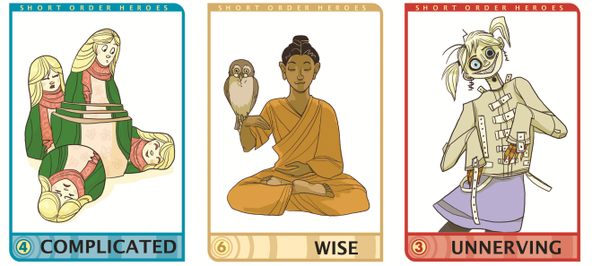
Short Order Heroes, a product from Calico Games

So, you should propably check out their website to know what the thing is. http://calicogames.com/index.html

I am a widget guy in roleplaying games. I like random tables and random rolls. I love inventing the things using my imagination but still I love some randomness every now and then. I've used methods like looking around describing a NPC and first thing I notice is scissors then obviously the NPC is a "sharp" guy. That short of things I love.

Image from Calico Games' website.

I have tried to make different types of cards but I don't like the crafts part of it too much. I can write stuff up but assembling, cutting, printing is not my cup of tea.

You can already see where I am coming with this. Short Order Heroes seems like a perfect solution for me. There are random numbers to fiddle with (how bad is the bad guy... card's number is 9 so he is PRETTY damn BAD). Also descriptions to create not only NPCs but anything (the forest is unnerving and complicated are basics but wise, that's inspirational!). The pictures are nice too to help visualize the things.

I am not into yet another rules but I can see how to use these cards in my games with the rules I play.

Can't wait to read around web how creative people will use these cards! And me wants too!


Wednesday, August 7, 2013

An interesting view on Werewolf: the Apocalypse by Sami Koponen

Picture from nguma.com


Sami Koponen has appeared (at least) twice in my blog. First time when I interviewed him and second time as a "quest" writer.

The small background is, that he helped me. A lot. And I wanted to give him my copy of Werewolf: the Apocalypse 2nd edition. Sami's a great rpg friend and a good writer.

But anyways, this is what he wrote about the game:
http://efemeros.wordpress.com/2013/07/19/werewolf-the-hukkapeli/

(The first link is in Finnish. But no worries, the following is Google Translated. Disclaimer: Google Translate and English to Finnish suck like Hydra's kiss. Bad.)

Link to Google translated Efemeros article HERE!

I enjoyed the text a lot.

Thursday, November 15, 2012

[Interview/preview] Magicians - The language learning RPG


Magicians: The language learning RPG

What if you could learn a foreign language via playing a role-playing game? Soon you can. Magicians is a modern role-playing game set in Seoul adding Korean folklore, superstitions and mythology to create an unique and dense fantasy setting.
In this game characters learn magic while they deal with high-school and university life and learn the mysteries and horrors of the world. There's lots of strange things going on under the surface.
The magic system is really interesting. Your character learns nouns and verbs used to cast spells. And spellcasting is only not in-game. You actually have to pronounce what your character is casting! The magic system allows players to cast more advanced spells as they learn Korean. That is sweet. Imagine Harry Potter where you use these magic words. In Magicians you spell Korean to cast spells.
There are also cards that help building a plot and adventures without preparation. These cards are drawn each round to get unique adventures every time cards are drawn.
Each player needs a set of cards and their characters to begin the game. Magicians is a diceless system. You only need cards and some Korean speak and you are ready to go!
Magicians: The language learning RPG sounds interesting enough so I decided to dig deeper. And what would be better source for information than the author himself!


Hello Kyle. Thank you for your interest in my blog and thank you pointing out your project. In the Kickstarter site you already have written some background for Magicians, but would you like to review it shortly here?

Sure! What I usually tell people is that it's Harry Potter, set in Korea - it's Harry Potter-like in that when the students are around the school and its surroundings there are a lot of fantasy elements that don't blend with a modern-day setting like haunted forests inside the mountain the school is on, catacombs and dungeons, and other such areas I drew inspiration from Asian influences like Journey to the West and The Three Kingdoms along with Korean mythology, folklore and fantasy; instead of seeing things like orks and trolls, dragons and goblins, you still get dragons, just the Korean kind that live in water and achieved their power from yeouiju (think dragon ball!), dokkaebi, which are similar to goblins but can turn invisible and summon any item in the world to them, three-legged crows that live in the sun, bonghwang and other cool creatures you don't normally see in fantasy games. However, when the students are in Seoul, I wanted there to be some cool urban fantasy elements so it's more like The Dresden Files where it's modern-day but it has all these layers hidden just beneath the surface for those that can practice magic and I draw on Korean urban fantasy, superstitions and folklore for cool ideas like an underground magic scene that uses chicken-blood tattoos or embed sesame seeds in their skin as a magical ritual or dogs that barter and collect souls and that wear the face of their victims, which all come from urban legends which I twist for the setting, or superstitions still in use in Korea like whistling at night draws snakes and ghosts to your door, insects shouldn't be killed at night because they could be carrying someone's soul in them or that crows and mice can turn into you or steal your soul by eating your finger or toe nails. It's a big, unique playground to play in I think.

Why did you choose Korean to be the language to be used and learned in this game?

I choose Korean because it's the only second language I speak at a level I'm comfortable with teaching and, since my major is Korean education - teaching Korean to non-native speakers, I'm going to be using the game as a basis for my thesis paper as well. Korean is a really cool, unique language that is really easy to learn and get into but is very deep, interesting and is very different from any other language I've seen. In particular, Korean Hangeul, the alphabet, only takes a few hours of dedicated study to master completely since it's phonetic and was made expressly for easy learning by a Korean king. 

Can a group of players start playing and actually enjoy the game with zero knowledge of Korean? What kind of tools does the game give for the group to start with?

I wanted the game to be something that people could jump into with very little knowledge of Korean, especially for people who hadn't played an rpg before, that's why I set it in modern day and added in all those cool elements but I also created the basic system which uses only 13 words to cast spells. In order to play the game at lowest level of difficulty (there are 3 tiers that build on each other as you learn and get better at Korean) you just need to learn those 13 words as you play the game and get better at pronouncing them. The game uses a smartphone dictation app to check you pronunciation so it's something you can practice and get the hang of even when you aren't playing the game. 

I understood that basically more advanced you get in Korean more advanced things characters can do in the game. It's like while you advance in Korean your character kind of advances also. Is this right?

It's not so much that the more you advance, the more advanced things you do - at any tier of difficulty you can cast any spell you want. There are 7 nouns and 6 verbs at the basic level, you choose one of each to cast any spell you can think of. The nouns consist of the elements - fire, water, earth, wind and then there is also living things and the five senses. For verbs there is create, damage, transmute, remove, compel, and perceive so it works a lot like Ars Magica. The second tier of difficulty takes away that archetypal approach so you have to choose your own noun and verb to suit the situation and build your vocabulary. The third and final tier has you speaking in full, complete sentences and learning grammar patterns you can plug your new-found vocab in and out of as well as learning more target vocab which are tied to types of magic. For casting spells having to do with time magic, you first need to learn numbers, to cast telekinetic spells you learn relative position, directions, etc.

Korean mythology and folklore sounds really interesting. How much tools does the game give to work with? Does it provide superstitious folklore, monsters and other?

I've got a whole bunch of setting material that's going to be in the book - Korean superstitions, folklore, creatures and monsters, urban legends all given a twist so that they all fit into the world of Magicians and so that people can use them in their own games if they want to mine some cool Asian influences for their own games. 

You pledged for 3000 dollars but currently are in over 23000 dollars. How do you feel?

The response the game has been really amazing - I really didn't expect it, I thought it would be this tiny niche within a niche that liked the game but what it turned out being was that it was interesting for all kinds of groups. People who want to just learn another language like the idea of another tool to do so, rpg gamers in general are all educated to begin with and are always looking for something cool and the fact that you can learn more of something and a useful skill while doing something that you already love doing is an awesome proposition I think.

 Can you actually learn Korean with this game?

Of course! The main idea behind the game is the same process that is applied universally when learning any language, first you start out with pronunciation, learning the alphabet, then you start learning some words and building your vocabulary, then you start learning grammar patterns that you use that vocab in as well as target vocabulary associated with language you'll use and need when speaking in everyday life - directions, time, adverbs and adjectives, past and future tense, etc. Not only will you learn Korean with this game but the core of the game is so universal that it will be easily hackable for other languages as well - which is why I'm putting out the "hack pack", a stretch goal we at 15k, which will detail expressly how to hack any and all aspects of the game - the setting along with the themes and tone you want to set and, especially, for different languages as well as some fun ideas for use with other languages that work differently than Korean, like those that use gender, etc.

(Kyle also provided me with this fun little comic about learning Korean in 15 minutes (LINK).)

But what is your roleplaying history?

My dad first introduced my twin brother and I to D&D back when I was in elementary school but it didn't really take as I got into computer rpgs more like Bladur's Gate and stuff; I didn't actually start gaming again until I came to Korea when 4th Edition was released - the guys over at Penny Arcade did an actual play podcast series that made me want to get back into it and I wanted to meet some more people and make some friends so I looked for and found a group and got started. We played 4th edition for awhile but I really got into it and was soon buying and reading rpgs both to play and just to read, I started GMing for the group and have run lots of great games - Marvel Heroic Roleplaying, Burning Wheel, Burning Empire, Mouseguard, Pathfinder, With Great Power,  Fiasco, Cathulhutech and all kinds of other stuff. I started designing roleplaying games as well but more as thought exercises and for fun - my first rpg I designed was a solo one to see how it would play, I made another one to teach how to play go-stop, a Korean gambling game that uses hanafuda cards and then I came up with a language-ed game after teaching English, reading about dictation apps and trying to incorporate elements I love from books about learning magic like Magicians, by Lev Grossman (the game started out as a IP project for Magicians, hence the name with Lev Grossman on board but the rights ended up getting sold to Hollywood for a tv show), Harry Potter, the Earthsea books or The Dresden Files.

Final words from you. What would you want to say about the project and what would you like to say for the people who already pledged and for those who are interesting of it?


To all the people who have backed the game, helped got the word out or both I'd like to say thank you! For those who are interested I'd say come to the kickstarter page and check it out! I've got actual play videos of the first few rounds of a game so you can see how it works along with a video of how the smartphone app works as well. We've already hit the 20k stretch goal which was for a Japanese hack of the game by Andy Kitowski, of recent Tenra Bansho Zero game and kickstarter success and at 30k we unlock a Chinese supplemental system for traditional Chinese by Jonathan Walton, creator of the Geiger Counter RPG, among others, so if you're interested in the idea but not so interested in the Korean language element of it we might have you covered!


_______________________________________________

The Kickstarter campaign page can be found in the following link. The project will be funded on Monday Nov 19, 12:00am EST so now is the time if you want to hop in!

Campaign link: http://www.kickstarter.com/projects/1858774754/magicians-a-language-learning-rpg

All the pictures are from Magicians roleplaying game.

Friday, November 2, 2012

[Review] The Magnificent Joop van Ooms for LotFP

The Magnificent Joop van Ooms is not an adventure. It is a small sourcebook for Amsterdam in 1615 and one magnificent person and his servants living there.

The book is small only 18 pages long what makes it easy to read and memorize.

Presentation

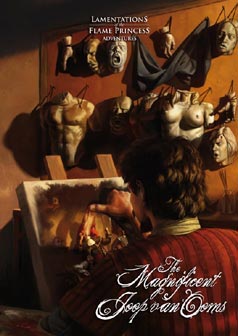
The cover art is really cool expanding to back cover. In cover you see Joop van Ooms messing with a painting of adventurers and, well, one of the adventurers is messed up also. The cover is stunningly done.

Inside the pages are in greyscale, the font is easy to read but a bit small and layout is clear. Pictures are great in black and white and the style reminds me a bit of some of the old World of Darkness art. Usually LotFP books' art are done in painting like style but this works also if artist(s) is/are great.

The Setting

Joop van Ooms lives in Amsterdam in year 1615. There are only two pages worth of information about Amsterdam focusing into The United Provinces and commercial scene of that period. Because the book is set in historical Amsterdam Referees can easily expand the details using various sources from historical books and internet. This both saves space from the book itself and gives Referees freedom to include extra details as many as they wish.

In my opinion even though this books is supposed to be in real Amsterdam it is easy enough to include in your favorite setting you use. Mostly because The Magnificent Joop van Ooms doesn't go to deep in the location description.

Rules Part

There are basically only two additional rules. One is chart for selling and buying in black markets and other is a random encounter table. The random encounter table has 50 possible encounters but some of those are pairs with a minor difference. Some of the encounters can be also seeds for adventures.

The black market table I am really disappointed at. You roll 2d6 + Cha modifier to see the result of selling and buying. Mostly it affects is the item available and what its actual price will be. There are also some boring extra effects after failed or successful transactions. But these are really, really dull.

After natural 1 & 20 chart what gives various effects and not just bonus to damage this was a huge disappointment. You can quickly see what price you sell or buy and does the vendor like you or not but that's it.

Joop van Ooms

There are three NPCs. Joop van Ooms, his guard and his lackey. All of these three are interesting persons but still easy to play.

Rules-wise Joop is a Magic-User but basically it only means his HP and savings. He doesn't use spellbooks, spells, spellscrolls or anything magical Magic-Users usually tinker with. Joop van Ooms magic is in his art and crafts.

Joop can alter reality - or cast spells - using arts like architecture, paintings, sculpturing, poems and so on. He is also an engineer like Da Vinci and he has created a couple of advanced crafts. Other seems to be useless but another can be a blast with "wrong hands".

There is also map for Oom's personal residence. How magnificent person he is his home is a little boring. The focus is in what Ooms is in person and what he can do and not where he lives. His residence is basically for hosting parties and creating arts.

The description of Ooms is interesting. He is really extraordinary person with his fanbase but also enemies.

Adventure Hooks

The book also gives possible adventure hooks. As adventure hooks these are not that detailed but that's the point. They give ideas and inspiration to put player characters involved somehow in Joop van Ooms. I think the adventure hooks are broad enough and easy to use.

The Number 8

Nice little detail is the number 8 Joop van Ooms avoids. In several different contexts it is present. And it is no good.

Final Words

The book is nice little piece of introduction to 1615's Amsterdam focusing on Joop van Ooms as a character, adventure hook and a background for adventures. It is quick to read and easy to memorize and simple to use. Only flaw is really boring black market table what could have been more interesting. It works yes, but is dull.

If you are looking for yet another LotFP adventure this is not for you. But if you want something you can use as a small inspiration for your adventures this is a great little book. A lot of work to use this is left for Referee but it gives you a good starting point for interesting play.

The official product page: http://www.lotfp.com/RPG/products/joop-van-ooms

Saturday, September 29, 2012

God that Crawls and other new LotFP items

This week I received Lamentations of the Flame Princess adventure God that Crawls. In addition I got fixed Green Devil Face #5 tables for natural 1 and 20. I expected it to be a4 print but it is a sturdy double sided card. Really cool looking. But because of that I have to join the d30 club.

I also got my Gardening Society membership card. It is freaking cool and damn weird. If you didn't know you would be all what in the earth with it. No spoilers about the text. Join the club to find out!


Monday, August 20, 2012

Got my Monolith and other goodness


Long wait rewarded with above items. I finally got my The Monolith From Beyond Space And Time. But also two extra items. Death Love Doom was published almost the same time so I added it and a bonus for waiting for The Monolith so long people also got Green Devil Face #5.

The Monolith From Beyond Space And Time is the main product of the trio. It is thicker than it was meant to be with great menacing art. And the valley is great place to put your adventurers in and the Monolith... haven't read that far yet!

Death Love Doom has a reputation being repulsive, but I found it awesome. I do like horror and core and all the grotesque but I see how Referees should be really cautious who they play DLD with. There are some taboos people find disturbing - genitalia and kids, both mutilated.

Green Devil Face #5 is Raggi's Fanzine of Lamentations Of The Flame Princess and it is sweet little trinket full of interesting small items you can use in your games. For example nasty raggian trap and alternative experience rules. There is a big layout botch with natural 20 (critical success if you will) table but it will be fixed later. Well, nothing that a real Referee cannot cope with and fix himself.

These three items in one package provided almost overwhelming excitement and awe.

Raggi did it again producing two great new products and a fun additional ideas in GDF.

Don't forget to visit the official LotFP website: http://www.lotfp.com/RPG/

Wednesday, April 18, 2012

D - Dungeons & Dragons Daggerdale review

http://en.wikipedia.org/wiki/Dungeons_%26_Dragons:_Daggerdale

Dungeons & Dragons: Daggerdale is game for both PC and Xbox 360. I got it from XBLA. The premise was good. D&D adventure game where you hack monsters, loot treasures, advance your character and so on but the gameplay was a big disappointment.

The cover art shows you heroes but doesn't tell
that they just keep running endless brown dungeons
killing thousands of monsters all over again.
The game takes place in Daggerdale dungeons and there it happens. The surroundings are all brown and boring. You run endless corridors and caves killing few different monsters. Lots of them. Luckily combat is fast but it gets dull after a while. Basically you just hack your way around. There were only a couple of exceptions to this so it didn't feel different to general gameplay. Fortunately the gameplay and controls are smooth and easy to use.

There are only four characters to choose from and all are pre-made race-class combinations and the variety of feats, powers and spells are narrow so there are not many choices to customize your character. I found out that playing solo Dwarven Cleric was best option. He doesn't need healing potions that much as he can spam healing almost all the time. It was easiest character to solo the game.

Loot is gold and items. You get gold usually from barrels scattered everywhere. It was stupid bursting all those barrels for few gold pieces. Who leaves gold in random barrels in random locations anyways? There are also treasure chests with items. I didn't use gold to buy items from vendors as you usually get enough new equipment from chests and drops from enemies. And for lazy people who don't want to turn items to vendors you can directly convert them to gold in your inventory. There's at least two achievements related to loot. Carry 100.000 gold at a time and collect one of every item in game. Every item achievement I got well before finishing the game. I suppose it is type of item. After first playthrough my Dwarven Cleric had over 50.000 gp. Most of the equipment are boring randomly generated generic magic items and most of the new items are worse than what you are carrying... so to gold you convert them quickly.

The adventure was mostly boring. Main plot was a little silly and all the additional quests were like go there do that come back. And kill tons of monsters in the way.

There are always more monsters than your party size (about multiplayer next). So most of the time you kill them. Unfortunately there are only few different types of enemies so it becomes a little dull seeing same or similar faces all over again. With healing power it was also easy. Without - more challenging and slower to advance, duller.

Multiplayer is always fun but it isn't that fun in this game. I didn't own headphones at the time I finished game also in multiplayer mode so I don't know how you can communicate with other players. There are no buttons to give simple orders (HALP, come here, follow, thanks) so it was sometimes a chaos trying to get people to follow the right direction, come to help you and find guys who needed healing and so on. It was just like four individual players running around and trying to conclude what other players are doing or want to do next. Also I found that if someone joins the game at some points the quest resets. It was annoying as hell. Doing 90% of the quest, see text KillMasta123 joined the game, then get reseted to the beginning, someone leaves, another takes his place, start again etc. When I played my quest I sometimes had to kick everyone out, quit multiplayer and do the quest myself to make advancement in my game.
Basically the one who is host is the one who's quest others join to help. It sucked that most of the players just took all the loot. Also those items they cannot use. I as a host kill monsters when some idiot goes and opens the treasure chest and finds dwarf only item and naturally takes it. Fastest player got the loot. Fortunately the gold gets shared but the item system was just shit. In many mmorpg loot is well done, like loot is "rolled" who gets it nevertheless who picks it up.
Also I didn't find any feature to see what level characters I join. Joining game with lvl 1 character where others are lvl 10 is pain in the ass. Get ready to be killed and standing in distance looking how others do everything. Fortunately when you die others can resurrect you standing near and pushing a button and you come back with few HP to continue. If everyone dies the quest ends. If players in multiplayer game have any common sense it is really easy.

The ending was cool though. Final battle was kind of epic and I liked the grande finale (won't spoil it but it was cool). I was just wondering how much I liked the final part of the game why the whole game couldn't be as good? It's like you run endless caves and corridors killing endless swarms of monsters doing mostly stupid quests and when you get to the good part it all ends.

Oh, and the level gap is 10 you can get with one walkthrough and a little extra effort in multiplayer. The trick is that you get an achievement getting all four characters to level 10. That is one boring task to finish the game four times or farm endlessly xp from random multiplayer games.

Don't remember how much this cost. 800 points maybe when I got it. Is it worth it? Hell no! It was okay the first game finishing the game but there is not much value getting back to it unless you are after achievements. There are also annoying graphic bugs in top of the fact that graphics are boring and location-wise the whole game is boring. Also there are no voice actors. You read by text what NPC's talk and get a grunt (hrhm, umh, urh) in the beginning of each text box. That is so lazy. And sounds? It doesn't matter if you play this game mute or not.

Could you get anything to your roleplaying from this? Nope. Too simple story, Daggerdale is presented shallow, quests are the kind you invent 5 minutes before the session starts etc. There is no value to improve or inspire your roleplaying gaming.

Gameplay: 4 stars because controls work and suit well for action.
Graphics: 1 star because they are dull and boring and there are glitches.
Story: 2 stars because not interesting enough and most of the quests seem too random and even 10 years old DM could write similar.
Overall: 2 stars because this game is boring, short, ugly and it doesn't offer enough variation for playing it again when you have already finished it. I finished the game and it had it's moments and turning brains to "kill-all-the-monsters" mode can be fun sometimes. Unfortunately there are dozens of games what do this kind of playing ten times better. Except achievements if you are after those.

Thursday, November 24, 2011

Mutants & Masterminds Review PART 1

First time I did read Mutants & Masterminds I did like it. I already had played Dungeons & Dragons 3.0 so I knew the basics how D20 system works and before that played simplified True20 system of Blue Rose. M&M is kind of between those two in complexity and above in character possibilities and customization. Still there are things I don't like about this D20 rules set.

Characters Without Class Nor Alignment


Classes I am ok with. But in this kind of game where heroes are all unique classes wouldn't work that well. But if you don't want to make a character from a scratch there are hero archtypes you can slightly custom to your own taste.
They aren't equal to classes which are base you create your character on but almost ready-to-play. Still, for those who don't want to use whole toolbox or are short of ideas there archtypes are welcome.

There is no alignment but somehow I feel that it (good, evil, lawful) could determine where character stands. BUT what else alignment does except being a part of game mechanics? You can write in your character description lawful evil superhero. Isn't that the same without mechanical use in game? Yes it is. I think D&D alignment system - even though somehow confusing - describes easily both character's moral and order.

True D20 Game With Only 20-Sided Die

This game only uses D20. Well, Dd20 system basically only uses D20 when determining successes but effects are simulated with different dies for example damage.
Which is more simple? In D&D roll to hit then roll damage what is exactly what die shows plus/minus something. In M&M:
"Characters in Mutants&Masterminds do not have hit points based on their level and Constitution bonus, and damage is not rolled using other dice. Instead, each attack has a damage modifier used to calculate a Difficulty Class. The character makes a Damage saving throw against that Difficulty Class and the result of the..." blah blah blah. Roll, calculate, roll against. How does that differ from actually rolling damage and settling for that? Or if you don't like hit points make damage steps. Light, moderate and heavy wounds. Damage dealt between 1-4 points is light, 5-9 moderate etc based on constitution. Character can take more lights but when those are used/marked they convert to next step. Well, check out Kult 1st edition.
Point is that this system in my opinion is too complicated. I didn't like it in Blue Rose either. But more about damage later and when you think about it, is it that bad?

Attacks of opportunity I didn't use in my D&D3.0 game (no minis extra complication) so I am pleased it isn't used here.

Character Creation

I did create a test character some time ago. It was ok. But there is a problem when I think harder. The problem is same I dislike GURPS character creation. You get a punch of points you must use for EVERYTHING. Its really hard to allocate points to abilities when you are not sure how many points your concepts powers will take. And then you try to balance your character so he can fly - well. Or he has this cool megacannon he is shit shooting with. So, you carefully allocate points here to get basics, move to powers to get core and continue jumping back and forward to balance with your points. And don't forget restrictions on max attack bonus etc. I do like point buy system for customization purpose but I prefer different areas of character having different point pools. Makes things less accounting and less mathematics.

The Abilities are same from other D20 games. I think those six cover really well characteristics although I always had a problem making difference between Intelligence and Wisdom. Skills I think work well in this genre.

Feats I am not so sure do I like them or not. They do give this little extra touch for character but they are way too mechanical in nature. I'd like more descriptional use-your-common-sense types and probably when I play I treat them that way. Less I have to open rulebook during the course of the game the better.

Super-Powers

Then what makes superhero game a superhero game; the super-powers. This would take ages to review. Let's say. You have tons of powers you can custom. And by custom I mean Xzibit Pimp my powers custom. You take energy say. Decide do you shoot it from your eyes, fingertips or mechanical cannon. Does it explode etc. Point is that you have basic power listed which you can custom for your character from it's origin to flaws. This is the super-power toolbox and it will take most of the time of the character creation. I have to admit this is the first and only supers game I've got to know so I am not sure how big the power section in this game is compared to others.

Back To Character Creation

Earlier I used therm "characteristics" when I actually meant abilities (dexterity, charisma and those). But actual characteristics chapter reads "filling in the details". It contains both writing fiction for your character. About his appearance, origin, motivation and so on. But also gives mechanical details for character sheet for example saving throw values, carrying capacity, hero points and so on. Hero points you can use to re-roll dice, improve defense, eliminate stun hits and other short-term advances for a certain situation. According to book hero points character has are meant roughly to last four hour session. If sessions are shorter GM may consider to award them back slowly or if sessions are longer than six hours more often. Basically hero points are replenished after a certain time mainly determined by GM.
In this chapter you can also choose weaknesses. For every weakness player is awarded 10 extra points for his character to spend in character creation. Weaknesses are common what you find in other games labeled "disadvantages" or "flaws". Those also contain rules how they work and what penalty they give in which situation. Yet again I like to use them when I see appropriate instead of reading when to use those. You know, yet less rules to remember. Particularly when you have several players who might not know or remember to use them right.

Devices are basically part two to super-powers. Super-powers are within character when devices are gadgets and mechanical items giving those super-(like)-powers. Devices can be anything from weapons to headquarters. You can also make super-powers devices just applying device flaw on them. That way you don't fly on your own, but fly with a device; rocket backback for example. Nice additional touch is random powerful device name generator. Roll D20 for first word and D20 for second word to combine with. And you might get a device called "The Kinetic Repulsor" or "The Anti-Matter Nullifier". Deal with those!

For those familiar with D&D 3.X combat rules are easy to learn. To attack roll D20 and add base attack bonus + strength modifier + size modifier. Ranged is similar but with dexterity modifier instead of strength modifier and subtract range penalty. Easy as it is.
Defense is 10 + base defense bonus + dexterity modifier + size modifier. That is the number you try to roll over when attacking to hit and wound your opponent. Lots of calculation but luckily you have already written those down in your character sheet. So just check out the number for your melee or ranged attack and add it to D20 roll. Same way skills work. Roll modifiers to your skill what you try to do, roll D20 and try to score over difficulty number determined by situation or GM.
What is really different from D&D 3.X is damage. This is when my brains crack. So when you hit with your attack you potentially deal damage instead of just rolling damage. Each attack has a damage bonus. Melee attack damage bonus is strength plus possible modifiers from for example super-powers. Ranged attacks use power level of weapon or attack type as damage bonus. If opponent is hit he must make damage saving throw with damage save bonus. Damage save bonus is constitution bonus + power bonuses + modifiers. Roll D20 and add damage save bonus against difficulty of 15 + attack's damage bonus. Then based on your success or failure determine how much damage is dealt. Success means no damage, fail means injured, fail by 5+ means stunned and fail by 10+ disabled. And there are two types of damages: stun and lethal with slightly different effects.
I think when you fight a few fights you get the gist of it but still to make some of the rules more simple why damage rules are this complicated? It does take several problems from hacking hit point per time away though. But still I am not happy with this. But it's similar to other D20 rules. Add this to that and bonus and modifier + D20 against this with that modifier or DC of this plus modifier. When you think about it and go deep enough damage works the exactly same way as other rules. It makes sense, but still I am not 100% convinced.

But there is alternative way to roll damage. After hitting opponent attacker makes roll D20 + damage bonus against opponents constitution bonus + power bonuses + modifiers + 15. Consult the table what type of damage is dealt based on success. I actually like this more somehow. Attacker rolls when attacker attacks. But still it basically is the same mechanics.

Another thing I hate are different types of actions. Free, half and full. Luckily there is a list of these and they most definately are print-to-sheet material for quick access. Other combat rules naturally cover initiative, movement and position, modifiers from situations and surroundings. Lots of tables to check on. Personally I am the GM who strips these and goes with the flow. Depending on what happens in game I give or reduce penalties and rule myself what modifiers take place. Thanks to World of Darkness games I don't need too detailed combats. I want my combat turns to go like this:
Player: "I jump over the cover and shoot him."
Me as GM: "Okay, from jumping and shooting you suffer penalties. It's hard to aim when in movement. Oh, and your opponent is in partial cover. Hmm take -7 to your roll."
Someone might argue that my style is not fair as penalties and modifiers are not written in stone and after few weeks similar situation might only be -5 or even -9 penalty to attack roll. Stable rules, people say, what work same way every time. I partially agree. Rules are good so situations have a norm what player character follows. But I want fast action. Instead of spending tens of seconds calculating every modifier and determining situations by the book I keep action fast and just say it. That is my style and basically rules wise it is wrong.
Breaking items is easy. Substance hardness + 15 is difficulty. There are also other little bits what are nice and easy to deal with. But what about grapple rules what commonly in roleplaying games are clumsy or even hard to understand? Attack roll is basically same as melee attack roll. After initiative grapple when you decide to hold your opponent make opposite checks next turn. You win, you keep your grip. Opponent wins and he breaks apart. There are also different things you can do in grapple like do damage or just pin. You can also make a group grapple... visualizing it makes me laugh out loud.
Also basic hazards and conditions are covered like starvation, falling, disease and radiation (you might re-allocate power points if radiation is exotic, or it might work like poison). I think rules cover in only 18 pages everything needed and personally for me half of that is gibberish. Not bad at all. At this point of rulebook roughly only one third left most of the material has been about character. Character creation, powers, devices etc. and at page 143 only 18 pages of hard rules. Not bad at all again.

Unfortunately, this is where I have read the book and will continue to read from this point. Gamemastering - Creating and running the universe is the next chapter. I will continue this "review" when I finish the book.

Friday, October 21, 2011

Reviewing: Ye Booke of Monstres for Call of Cthulhu


Liked re-writing my Vampire: the Masquerade review in the last post, so I thought I'd continue re-reviewing games. This original review I wrote is from 2009 for Roolipelit.net forum.


Ye Booke of Monstres - The Aniolowski Collection, Volume 1

Ye Booke of Monstres kansikuvaSourcebook for Call of Cthulhu introducing a bung of monsters from a selection of authors inspired by H.P.Lovecraft's work and Mythos. Author of this sourcebook tells that some of these Monsters aren't official Mythos entities but they fit in the world of Cthulhu. Monsters from this books are collected from 70 years of novels and short stories and different writers.

Outlooks
This is a thin book with only 59 pages + a few extra including index. The cover is dark and pretty cool although the art is a bit amateurish. From distance it is great but when examining the details you discover it.

Book is with soft covers and black and white illustration. Layout is lame. Every monster within includes a picture and monsters are divided with big headline and a line what shows pretty well where one description ends and the next starts.

Most of the illustration is similar to Call of Cthulhu rulebook illustration. Monster pictures are a bit scruffy. Illustration isn't that sterling although you can get a picture what the monsters are supposed to look like. I really like the fact that every single being is illustrated when you realize how strange and multi-dimensional some of Mythos beings can be. Points for the effort even though some of the monsters look more hilarious than insanity eating. But it is hard to draw something what is four dimensional, unspeakable and defies all physical laws. 
Olentoja ja hirviöitä

There are plenty of creatures. 69 total. You can do the math yourself. If there are 59 pages for creatures and 69 of them the descriptions cannot be that broad. Also when stats are included for everything here. This is the weakest link in the book, not enough information. Too many monsters tucked in a too small box. Most of the monsters only get few sentences for description.
Usually motives of creature or location is totally missed when information tells usually that monster attacks immediately and fights 'till the end. Also because some monsters are too mighty to fight with rules the stats are just for their ego boast.

I am bitter about this. Now the book is more like monster manual giving combat stats for monsters instead of actually adding more into Mythos and strangeness. You get a picture, stats, small description and that's it. Rest is totally up to the Keeper to use that monster in his adventure. In my opinion Mythos needs more monster information what doesn't tell the stats but how you can use them in your game.

Also for some reason there are plenty of human like monsters with big earlobes who look more like new age science fiction beings than monsters. I personally don't like them.
For Gaming

Even though the books lacks all the interesting information - actually describing the chreatures - it might give inspiration and variety for core books monsters. Problem is, that the Keeper don't get story seeds to use these. He gets combat stats but creating the adventure still depends on the Keeper. I like descriptions what give ideas how to use things. But if your gaming group is bored in ordinary Mythos monsters in core book, this might give small addition from other authors to check out. Although I don't have much of experience about Call of Cthulhu sourcebooks I bet there are better investments to put your money into to get more abominations to use in your games.

Some of the monsters are lame and stupid but there are few I really liked and actually got adventure seeds around certain monsters. Creative Keeper can make adventures from anywhere, so for those this might be a good inspirational source.
 Final Words
Plenty of new Mythos creatures but unfortunately short descriptions. You get stats but not what you really want to use. Thin and fast to read. Cover is not that bad and picture of every monster is great bonus. This could have been so much more. With more information about creatures or narrowing some of those to release more space. Some of these are really stupid.
I am not sure would I like this more if I was familiar with books these monsters are in. You know, saw it on book, get the stats. But for me who is unfamiliar for the fiction behind these this is waste of time. Oh, not so. There are few monsters I actually got inspiration to build campaign around. So it isn't throughout a bad sourcebook.

Points

1 for not providing enough information about monsters.
3 because cover is kinda neat and every booger is illustrated
1½ because I got few inspirations.

1½ final points. You don't need this. If you got almost every single Call of Cthulhu sourcebook, you can buy this. Or if you get this under 5 dollars, consider this. This doesn't change your CoC experience.

Review: Vampire: the Masquerade Revised

This is actually a review I wrote back in 2008 for Finnish roleplaying games forum. I use it as a base for this new review, but modify some parts of it according to today and how I feel Vampire: the Masquerade now.

Short History Of Me And Vampire: the Masquerade

I bought V:tM in late 90's, because I already had Vampire: Dark Ages what I myself enjoyed but my gaming group wasn't that interested in. Main reason was that my group was mainly into fantasy and V:DA was too close being fantasy but it wasn't fantasy enough.
So when I heard about Vampire: the Masquerade and saw it in my local gaming store I decided to buy it. It was set in modern world what made a huge difference. The current version was Revised.

I ran few games and chronicles with it but still my group was more into fantasy so I couldn't play it as much as I wanted. I did know a gaming group who played mostly V:tM but didn't like those guys. You know, later goth Sabbat freaks!

When I met my current girlfriend she got into Vampire gaming and I have played chronicles over 8 years regularly with her. It is our most played and most favorite game. I managed to Storytell and invent chronicles and plots even though I only had the core book. It took many years when I bought my first sourcebook to spice up my gaming.

Vampire: the Masquerade is my ultimate favorite of roleplaying games, and this is the review of it.


Vampire: the Masquerade

A Storytelling game of personal horror.

Vampire: the Masquerade is a game what divides opinions from awe to hate. When the new "edition" of it, Vampire: the Requiem, was launched Vampire: the Masquerade was not forgotten. 20th year edition is a proof of that.
Some of the Vampire players did go with Requiem and never looked back. Some tried the new but decided soon enough that old classical Masquerade was better. New to White Wolf's Vampire are most likely to pick up Requiem, as it is the one in print. But there is still curiosity towards the original 90's gothic punk horror game.

Hardcover

In addition that the book is really stylish with its marble like green cover and simple but catchy logo it is also quite durable. I can say that I have read the book numerous times and its been in darkest corners of earth and used a lot, but still it is in good shape. Only small problem is, that the binding is a bit loosen. Otherwise, it is in really good shape. I could say that the book is really durable.

Prologue: A Gathering of Beasts

Like every White Wolf product, also Masquerade starts with fictive story. Before each chapter there is one page fiction, but in the beginning the story is almost like a short story. Also in the back there are basically two short stories. The last is one page but entertaining and in rules there is also a story about a Vampire in different ages from history to today. It introduces World of Darkness in vampire's point of view.

These stories give nice additional information about Vampire. They are entertaining to read and generally well ridden and usually give individual's view on things what makes them good material to get into the thoughts of vampires. Some of these stories might be suggested for player to read to get a feel. Stories focus on a certain clan you can give for a player to read who is going to play that clan.

Only little problem is that some of these stories have a really messy font. It makes reading a bit slower and you might focus more on the font than actual text.

Introduction

The first actual chapter, the introduction covers quickly and roughly playing of Vampire: the Masquerade, basics to storytelling and the difference of Storyteller (Game Master) and a player. After that the chapter covers some real world myths about vampires to World of Darkness facts about vampires. Also basic vampire activities like feeding (drinking blood), embracing (making a vampire) and other basics.
Also the book is covered from which chapter you find which thing. How-to-use-this-book guide and also different sources for inspiration are covered from books to movies.

Also LARPing Vampire is quickly covered, but there are no real rules how to LARP (Mind's Eye Theater is for that).

For Vampire elder this chapter is a bit unnecessary but for a fledling it is good information to get an overview what Vampire: the Masquerade is about.

In my opinion maybe the most important part in this chapter is telling the differences of pop-culture and mythical vampires against World of Darkness' view about vampires.
Chapter One: A World of Darkness

This chapter focuses on the setting of World of Darkness and in vampire society, hierarchy and customs. Text is well written and focuses on what is important. There is not too much struggling to get a nice overview of each thing covered. Naturally in core book everything cannot be covered, but this is a good base to get started.

There are no rules or any other mechanics in this chapter. Just fluff and setting text. Vampire hierarchy, what prince is, population, rules of the Vampire society and other basic things are covered but mostly in Camarilla view.

But as these things are explained densely some topics leave questions. It might annoy a Storyteller who wants to know anything but in the other hand it leaves space to fill the holes yourself. It depends what you like and in numerous sourcebooks these details are mostly covered with detail. For a core book this is good basic information although in some parts as a starting Storyteller there were topics I would wanted to know more about.

There is also Lexicon what White Wolf uses. Encyclopedia of words vampires use. Nice detail White Wolf uses to give additional depth for both characters and NPCs to use in dialect.

Chapter two: Clans and Sects

Basically clans are the character classes of Vampire: the Masquerade what you choose when creating a character. Each clan has their own weaknesses, set of disciplines they learn easier, motivations, backgrounds and view of other clans. Clan descriptions are stereotypical but easy to pick up for beginner players. Advanced players can think out of the box and create characters what aren't what clan description says.

For example it is easy for new to Vampire player to pick up between Brujah the gang member, Ventrue the businessman or Toreador the artist. Advanced player might create a Brujah artist, Ventrue gang member or Toreador businessman.

In my opinion it should be more clearly stated that these are only stereotypes, not character concepts. I don't know how many have played or plays clans as told without experimenting with individual characters in the clan. I know I did.

There are three sects. Camarilla what gets most of the attention, Sabbat what leaves too many questions open because of it's different views and is almost unplayable in a more deep way and the Independents, who are clans not following Camarilla or Sabbat. Also Camarilla clan member might be part of the Sabbat and vice versa.

There are total of 13 clans and caitiff. Caitiff is basically your custom vampire. Clanless. There are both disadvantages and advantages for being a caitiff. Mostly disadvantages are in the story, not in rules. Most of the clans are in Camarilla, only two in Sabbat and few in Independent. Although Sabbat does have antitribu members who are individuals from clans belonging in different sect, but whole antitribu concept isn't explained that much.

There is no enough information about clans and sects. I can understand it, but deeper political game is hard to achieve with the information provided. This is when sourcebooks about sects and clans kick in. If you don't want to invent everything yourself, you are going to need these books.
   The variety of these 13 clans is good. Every player can find their own (stereotypically) from figters (Brujah),    businessmen (Ventrue), aesthetic artists (Toreador), sneaky assasins (Assamite), wizards and magisters (Tremere), monsters (Tzimisce), classical sewer dwellers (Nosferatu), cultists (Followers of Set) and so on. Also some bloodlines are introduced for slight variation what usually is about starting disciplines but there is no meta data about these.
Chapter Three: Character and Traits

In default character creation starts figuring out what kind of character you want to play. Background as a human, how he was embraced and who did it. What motivates her and so on. To make this easier there is a list of questions player can answer about her character. When the background is done the technical character chreation begins.

After choosing a clan what determines weakness and starting disciplines character creation is really straightforward, simple and fast. Attributes and abilities (skills) are divided each in three categories from which player chooses what is first, second and third to get different amount of points to divide between those. Attributes are physical (strength, dexterity, stamina), social (manipulation, charisma, appearance) and mental (intelligence, wits and perception). There are total of 30 skills. There are also backgrounds what give different advantages for characters like higher generation, famous sire, fame or wealth. Unfortunately list of backgrounds is in my opinion too short in core book.

Disciplines (the supernatural powers of vampires) get three points to share to and they are determined by clan of character. Some changes for initial disciplines can be made though. Last touch is to spend few points into conscience (or conviction for most of Sabbat vampires), courage, humanity (possible path for Sabbat) and so on.

None of these are marked with a number, but coloring balls. Fours spent points to driving skill means four colored balls. Each ball represents one die to your dice pool what is covered in rules mechanically. Character sheet is simple but stylish.

Further in this chapter skills are introduced what they mean and examples of how they work and what different values represent how good character is in that skill. Every skill has few sentences of fiction.

For normal character range of attributes is 1-5 (exception Nosferatus who cannot get any dots to appearance). Each attribute starts with initial value of 1 (except Nosferatus with ugly face). Skills are in range of 0 not learned to 5. With higher generation higher values might be possible.

In skills there is a small problem though. Some skills are not covered at all, and some are a bit too focused on a certain thing. This serves genre and how Vampire is meant to run but I have had several situations where there is no skill to use in a certain task. Fortunately there are new skills introduced in sourcebooks and players can invent their own skills if they will.

In the end of this chapter there are mechanics directly for playing a character and experience section. Experience points are mostly achieved from good roleplaying, characters personal advancement and advancing in adventure or chronicle. There are no experience values for looting or killing, but experience is more abstract. With experience points player can advance his characters attributes, skills and powers. The price depends on the category and how many dots there already are. Skills are cheapest to advance and disciplines outside of clan are most expensive.

Last you have freebie points to share where ever you want. Also you might get freebie points from flaws or spend them in merits described in appendix.

Chapter Four: Disciplines

Disciplines are vampire's supernatural powers what distinct them from mortals (well, in addition to needing blood, being basically immortal, unable to walk in sunlight and other vampiric characteristics). Disciplines are part of vampire blood so some of them need bloodpoints to trigger. Blood points can be gained more from feeding. And if you get low on bloodpoints, you get hungry and might fall in frenzy - vampiric uncontrollable rage. Bloodpoints might be concidered as some kind of magic points if you will. In addition some disciplines need willpower to be spent. Willpower is mental strength what you use to trigger certain disciplines, get automatic success or to resist some disciplines used on you. You get willpower back playing according to your character or possibly one after each session if Storyteller says so.

There is wide variety of different kind of disciplines each with five subcategories. Each dot in one discipline opens new powers character can use from that discipline class. Many traditional vampire powers are included like mind control, turning into a wolf, inhuman strength, supernatural haste and so on. Also some clans posses magic like disciplines like boiling another's blood.
Some of these disciplines are shared by different clans, but some disciplines are clan specific. One small problem with descriptions is that you need to read a bit to find what exactly the discipline does and how it works mechanically. In my opinion this should be more clear.
Chapter Five: Rules

Basic mechanics of the game are fitted in only seven pages. These seven pages mostly include how you roll dice. More advanced rules like combat are followed after this chapter. Only function of this chapter is to introduce the dicepool mechanics. The basics are fast to learn though.

Rules are really simple. When character tries to do something Storyteller tells what attribute and ability (or other character trait) is used and dots in these tell how many dice are rolled. Only dice game needs is D10, but you need plenty of them. At least 10 (per player if you want) to make playing comfortable.

The basic difficulty is 6 and each die result of a 6 or more is a success. More successes you get the better the outcome is. Faster you fix the computer or more damage you possibly deal. Results 1 decrease successes. If there are no successes at all but one or more 1 you botch. Something goes horribly wrong. If you have a specialty in skill (four or more dots, get specialty for beneficing in a certain situation) you can roll results 10 again (note: I have houseruled this. You roll 10 always again, specialty gives bonus die).

If task is more difficult, the target number needed from rolls is higher. For example 8 or more. In easier difficulties target number is lower. A rule of thumb is that if difficulty is equal to character's dicepool no roll is needed. Exception combat of course. 

Even though system is fast and dicepool is fast to determine as is successes, there is a flaw. Basically better you are and more dice you roll the higher change is that you get those unwanted ones.

Chapter Six: Systems And Drama

Chapter goes deeper in rules with combat. Base is same with basic mechanics. You roll Attribute + ability against a difficulty to hit. Extra successes after the first one give bonus dice to damage dicepool. Damage is determined by these bonus dice and weapon damage dice or in melee weapon damage and strength. You roll as many dice as you have damage and results over 6 are one point of damage. After damage is resolved opponent might have a possibility to soak damage with his stamina, armor and Fortitude if he possesses that discipline. The remaining is how much damage is dealt.

In my opinion Requiem basically does this better. In Masquerade to get a resolution of shooting with a shotgun you first roll to hit, then you roll damage with possible more dice and then opponent rolls to soak the damage. Three rolls with lots of dice in each. Player might have dicepool of 8 to shoot with shotgun and when he gets 7 successes, he can add 6 to damage. Shotgun does 8 damage so now player rolls 14 dice from which you count over 6's to actual damage. And then soak roll is rolled to determine how many successes decrease the damage. For a Storytelling game a bit too clumsy in my opinion.

Remaining of this chapter is for damage rules. Different types of weapons deal different types of damage. Bashing for blunt, lethal for bullets or sharp objects and aggravated for vampires from example fire. Also vampires soak damage differently than humans. Vampires and human characters do share exactly the same health bar, but still shooting the vampire most likely does less damage than shooting a human. Little extra to remember.

Also rules for mental health and conditions are covered and enviromental lethality as fire, electrocution and falling.
Also some technical stuff about embracing a vampire or making a ghoul, but these are more fluff than mechanics. Vampiric uncotrollable rage and fear of fire are also covered here.

Chapter ends with game example what tells in detail how different actions work.

Chapter Seven: A History of the Kindred

Longish few page story vampire telling of history from middle ages through world war to this day. Interesting and well enough written but basically unnecessary information. It can give some ideas for character history and it might give depth for World of Darkness but you can survive without it. Short story in between.
 
Chapter Eight: Storytelling

For Storyteller possibly the most important chapter. How you run Vampire: the Masquerade? What kind of adventures and chronicles you could run? What about the plot? How to make a good adventure? This chapter answers these questions giving adventure seeds to use. Most of the adventure seeds are good enough to build whole campaign around. Nothing is pre-written though. These are mainly for inspiration. No actual ready to run adventure.


Chapter Nine: Antagonists

This is the "monster" section of game. It lists different organizations and even other supernatural beings with stats and descriptions to use in game. For me this is a little waste of time and space, but if you quickly need stats for a biker gang member of agent, you got it. Also wrights, mages, werewolves, changelings and others are introduced but the information is so narrow you can hardly use them except as a punching bag. Of course as all these other supernatural beings have their own rich in detail game line it would be hard to include information here.
So, if you want to fight a werewolf, here are stats. If you want a plot with mages, you better go and buy Mage: the Ascension to use.


Appendix

For advanced players appendix provides moral paths instead of humanity for characters who don't fallow humanity any more, but instead a different moral code of vampires. There are several different paths with their own different moral codes. These might be hard to play for beginners but can give more depth for advanced players.

Also merits and flaws to buy in character creation. Merits are advantages you spend points to, flaws are disadvantages you get points from.


Conclusion

So, what Vampire: the Masquerade is? A neat book, good enough system with a bit too clumsy combat resolution... there are flaws and it is not perfect. I think that it is the setting that makes the book great. Requiem might be a bit better in some parts of the mechanics, but the setting is what you like or don't like. Vampire: the Masquerade is blamed to be too complex in setting with too much information to even tangle itself with it. I find that there is plenty of sources to choose from. But as this is core book review and not Masquerade setting review, I'll leave it to that.

Even though Masquerade has been died for some time the 20th special edition tells it is still liked. It still has fans. I am one of those people who love Vampire: the Masquerade. 

It might be that fledlings might be hard to "get" this game as Requiem is more modern in system and obviously easier to obtain. But if you forget the rules and availability you have two different settings. World of Masquerade and World of Requiem. That is what you choose between. I choose Masquerade.

4 points for how it looks. It is neat book with decent art. Some of the pictures are horrible though, but that is what roleplaying games usually get.
3½ points for rules. I like the basic concept of rules but combat is a bit too complicated. Although the game is easy to custom and house rule, so 4 points would be good also. Also you some meta data leaves you cold and you basically need sourcebooks. But as I review the game as it is, 3,5.
5 points for fun. I have played Vampire: the Masquerade a lot. I have enjoyed it so much. I have had great drama, lots of laughs, and dreadful tragedy in games. Players are the ones who make the game but I think that Vampire has been the inspiration.

4½ points total. Might be unfair to give this high score, but it's how I feel. For a game, 3½ is the score. For what Vampire is for me, 4½.